
Augusta County, Virginia
Piedmont Battlefield
Hunter’s Decisive Valley Victory · June 5, 1864
Explore the rolling ground where David Hunter’s army broke William “Grumble” Jones’s Confederate line, opening the road to Staunton and the next stage of the Lynchburg Campaign.
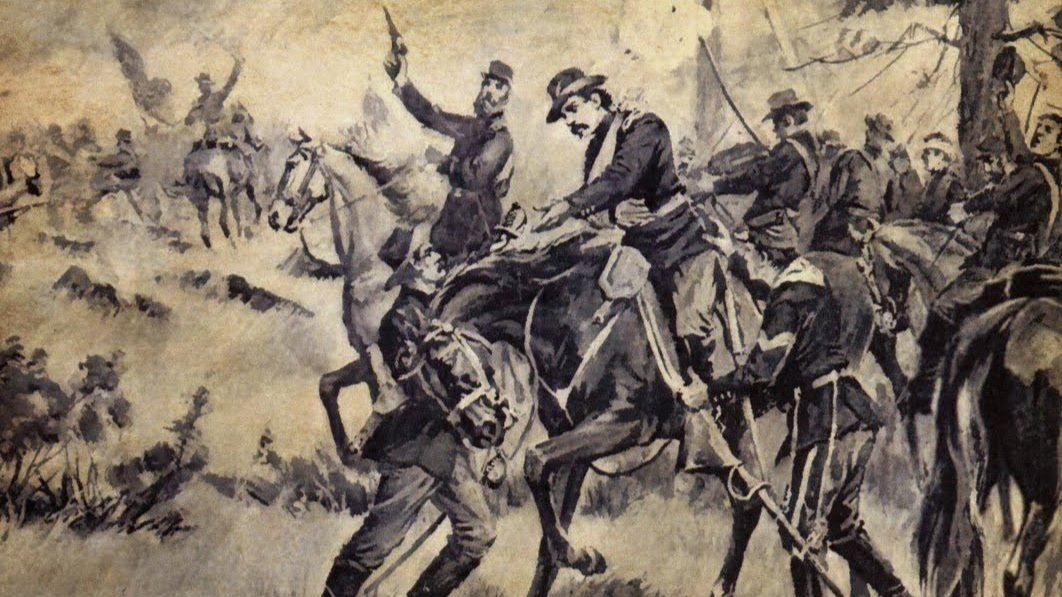
Historic sketch of the Battle of Piedmont

The battle in brief
A Flank Attack Breaks the Confederate Line
After the Union defeat at New Market, David Hunter renewed the advance up the Valley while William “Grumble” Jones gathered a Confederate force to stop him north of Piedmont.
Two Union attacks against Jones’s position failed. Federal artillery then gained the upper hand, and Joseph Thoburn’s infantry found the exposed Confederate right. Their assault struck the flank, Jones was killed while trying to restore the line, and the Confederate position collapsed.

- Result
- Union victory
- Date
- June 5, 1864
- Captured
- More than 1,000 Confederates
Plan your visit
Two Places to Begin
Piedmont is a rural battlefield with limited facilities. Use either designated parking area, then open the interactive map to understand the historic landscape.

North Parking Lot
Battlefield Road (Route 603)
Augusta County, Virginia
Begin near the Virginia historical marker for an overview of the battle and the ground where Jones formed his main Confederate line.
Small rural parking area · No restrooms · Use the map before arriving

South Parking Lot
Battlefield Road (Route 603)
Augusta County, Virginia
Use the southern parking area to orient yourself to the later stages of the battle and the landscape associated with the Confederate collapse.
Small rural parking area · No restrooms · Use the map before arriving
Southern Shenandoah Civil War Audio Tour
Free web-based tour
Begin wherever you are
Use narrated stories, historical photographs, and maps to interpret Piedmont and connect the battlefield with the wider 1864 campaign.
No download required · Free mobile experience
Before you go: Piedmont is a rural battlefield with no visitor center or restroom on site. Park only in designated areas, respect private property, and use the interactive map to orient yourself before leaving your vehicle.
Explore the battlefield
Find Your Way Across Piedmont
Use the interactive map to compare the two parking areas with the historical markers, memorials, and surviving battlefield landscape.
The history
The Battle of Piedmont
June 5, 1864
- Result
- Union victory
- Union commander
- David Hunter
- Confederate commander
- William E. Jones
- Campaign
- Lynchburg Campaign
After the Union defeat at New Market, Maj. Gen. David Hunter replaced Franz Sigel and resumed the advance up the Shenandoah Valley. By early June, Hunter was moving toward Staunton, an important railroad and supply center.
Confederate Brig. Gen. William E. “Grumble” Jones assembled troops north of Piedmont to block him. Jones formed his line across broken, rolling ground, using ridges, woods, and fences to strengthen the position.
Hunter sent Jeremiah Sullivan’s division forward. Two attacks by Augustus Moor’s brigade were repulsed, while Capt. Henry DuPont’s Union artillery fought to silence the Confederate guns.
During the initial attacks, Maj. Gen. Julius Stahel personally led dismounted Union cavalry supporting the infantry and was shot in the shoulder. After surgeons bandaged the wound, he returned to the front. Union soldiers cheered as he was helped back onto his horse. In 1893, Stahel received the Medal of Honor for his leadership at Piedmont.
On the Union right, Col. Joseph Thoburn discovered that Jones’s flank was vulnerable. Thoburn’s men advanced through difficult ground and struck the Confederate right. Jones was killed while attempting to rally his troops, and the defense unraveled.
The Union victory opened the road to Staunton, which Hunter occupied on June 6. His campaign continued toward Lexington and Lynchburg, forcing Robert E. Lee to divert Confederate troops back into the Valley.
How the fighting unfolded
From Frontal Assault to Flanking Victory
Ridges, woods, farm lanes, and an exposed Confederate flank shaped the course of the fighting.
- May 21
Hunter Takes Command
David Hunter replaces Franz Sigel and prepares to renew the Union advance through the Valley.
- June 4
The Armies Converge
Hunter maneuvers around Confederate resistance near Mount Crawford while Jones concentrates north of Piedmont.
- June 5 · Morning
Two Assaults Are Repulsed
Moor’s Union brigade attacks the Confederate position twice and falls back under heavy fire.
- June 5 · Afternoon
Thoburn Strikes the Flank
Union infantry turns the vulnerable Confederate right while Federal artillery dominates the opposing guns.
- June 6
Hunter Enters Staunton
With Jones dead and the Confederate force routed, Hunter occupies Staunton and continues south.
Preservation and new public access are bringing the story into view
Preservation in action
Protecting the Ground Where the Line Broke
The Shenandoah Valley Battlefields Foundation began its work at Piedmont with the Cline Tract and continues to protect key portions of the battlefield core. New parking, interpretation, and public access are making this largely private agricultural landscape easier to understand.
Protected tracts preserve the ridges, fields, and approaches that shaped the Union assaults and Confederate defense.
Designated parking areas and interpretation help visitors experience the battlefield while respecting working farms and private property.
Ready to explore
Plan Your Visit to Piedmont Battlefield
Begin at one of two designated parking areas, open the interactive map, and use the audio tour to understand a landscape with limited on-site facilities.