
McDowell, Virginia
McDowell
Battlefield
Stonewall Jackson’s
First Valley Victory – May 8, 1862
Climb the rugged slopes where a bold Union attack struck Jackson’s larger Confederate force and turned Sitlington’s Hill into one of the fiercest battlefields of the 1862 Valley Campaign.
“Reconnaissance at McDowell” by Bradley Schmidt

The battle at a glance
A Daring Attack on Sitlington’s Hill
On May 8, 1862, outnumbered Union troops advanced up a steep mountain slope to disrupt Stonewall Jackson’s westward offensive.
For four hours, Federal regiments pressed Confederate defenders through woods, ravines, smoke, and gathering darkness. The Confederate line held, and the Union force withdrew toward Franklin during the night.
- Date
- May 8, 1862
- Result
- Confederate victory
- Commanders
- Robert Schenck & Robert Milroy · Thomas J. Jackson & Edward Johnson
Plan your visit
Choose Where to Begin
Begin at the battlefield orientation center, climb to the Confederate battle line on Sitlington’s Hill, or follow the driving tour across the mountain landscape.

Highland County Museum & Battlefield Orientation Center
161 Mansion House Road
McDowell, VA 24458
Start in the 1851 Mansion House, which served as a hospital during the battle. Exhibits introduce the fighting at McDowell and the wider history of Highland County.
Season: second weekend in March–October 31 · Thu–Sat 11–4 · Also open by appointment

Sitlington’s Hill Battlefield Trail
Trailhead on US Route 250
East of McDowell, Virginia
Follow the interpreted trail to the crest where Confederate troops met the Union attack. The steep route climbs through the same rugged terrain that shaped the battle.
Open daily, dawn to dusk · About 2.8 miles round trip · Roughly 600 feet of elevation gain · Free admission
Battle of McDowell Driving Tour
Eight historic stops
Staunton to Camp Allegheny
Trace Jackson’s march west, explore the battlefield, and continue through the mountain corridor followed by both armies before and after the fighting.
Lengthy route over mountain roads · Download before arriving · Drive carefully and allow ample time
Before you go: The Sitlington’s Hill trail is steep and strenuous. Wear sturdy shoes, carry water, and allow about two hours for the round trip. Mobile service can be limited in Highland County, so download the driving guide before arrival. Museum hours may change seasonally.
Plan by time
Ways to Experience McDowell
A focused visit
60–90 minutes · Begin at the orientation center, explore the historic village, and view Sitlington’s Hill from the valley.
A battlefield hike
About 2 hours · Follow the interpreted trail to the Confederate battle line and return to the US 250 trailhead.
Half a day or more
Combine the museum and battlefield trail, then use the driving guide to follow the armies across Highland and Augusta counties.
Explore the battlefield
Find Your Way Through McDowell
Use the map to locate the village and battlefield trailhead, then open the free driving-tour guide for directions and interpretation at eight historic stops.
The history
The Battle of McDowell
May 8, 1862
- Union attackers
- About 2,400
- Confederate army
- About 9,000
- Union casualties
- 256
- Confederate casualties
- 498
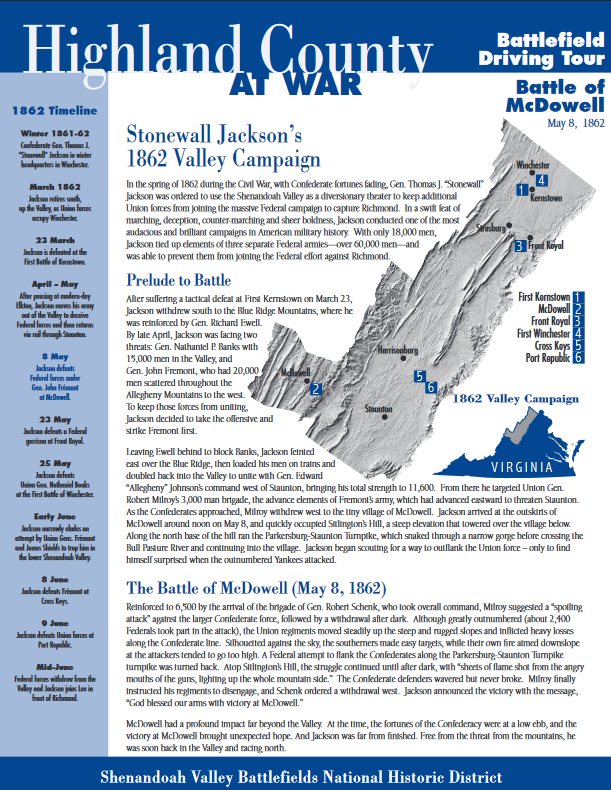
In the spring of 1862, a string of Confederate defeats placed Staunton in danger. The town was Stonewall Jackson’s supply base and the Shenandoah Valley’s only railroad connection with Richmond. If Federal troops seized it, they could sever a transportation link Confederate leaders considered vital.
From the mountains of western Virginia, Brig. Gen. Robert H. Milroy pushed beyond his orders at Monterey and occupied McDowell as a base for movement toward Staunton. Brig. Gen. Edward “Allegheny” Johnson’s Confederates withdrew from Shenandoah Mountain, while Maj. Gen. Nathaniel Banks threatened from the north. Jackson feared the two Federal columns might unite against Staunton.
Jackson responded with deception. He marched east across the Blue Ridge as though abandoning the Valley, then returned by rail to Staunton and joined Johnson. Their combined army—about 9,000 men—advanced west through Buffalo Gap on May 7. Milroy contested the approach before falling back to McDowell.
On May 8, Jackson and Johnson reconnoitered Sitlington’s Hill, whose two wooded knolls towered above the village. Johnson placed troops along the crest while Jackson searched for a route to bring up artillery for an attack the next morning. Meanwhile, Brig. Gen. Robert C. Schenck arrived with 1,500 exhausted reinforcements after marching thirty-four miles in twenty-three hours.
Rather than withdraw without testing Jackson’s strength, Milroy proposed a “reconnaissance” that became a determined assault. At about 3 p.m., roughly 2,400 Federal soldiers crossed the Bull Pasture River and climbed nearly 700 feet up slopes that were extremely steep in places. Ohio and western Virginia regiments struck Johnson’s line, at one point confronting former neighbors serving in the Confederate 31st Virginia.
For about four hours, charges, countercharges, and close musketry swept the hillside. The 12th Georgia alone lost 182 men, and Johnson suffered a serious ankle wound. After sunset, low on ammunition and unable to break the Confederate position, the Federals returned to McDowell.
At about 1 a.m., Schenck and Milroy left their campfires burning and withdrew toward Monterey and Franklin. McDowell was a costly victory: Jackson reported 75 killed and 423 wounded, compared with 256 Federal casualties. Yet strategically it secured Staunton and freed Jackson to resume the rapid Valley Campaign that soon carried his army north.
Read William J. Miller’s full article →
The landscape in contemporary sketches
McDowell Through a Soldier’s Eyes


These sketches were drawn by Sgt. Oscar Ladley of the 75th Ohio Infantry, detailing the Union and Confederate positions around Sitlington’s Hill and the town of McDowell.
How the battle unfolded
A Threat to Staunton Becomes a Mountain Battle
Follow the campaign from the converging Federal threats through the fight on Sitlington’s Hill and the withdrawal after midnight.
- Late April
Staunton Is Threatened
Milroy presses east from Monterey while Banks’s army approaches from the north, placing Jackson’s supply base and railroad link at risk.
- Early May
Jackson Deceives the Federals
Jackson feints east across the Blue Ridge, then returns by rail to Staunton and unites with Allegheny Johnson.
- May 7
The Confederates Enter the Mountains
Jackson advances west through Buffalo Gap. Milroy contests Shenandoah Mountain before withdrawing to make a stand at McDowell.
- Morning · May 8
Both Sides Prepare
Schenck’s 1,500 reinforcements arrive after a punishing forced march, while Johnson occupies the two knolls of Sitlington’s Hill.
- About 3 p.m.
The “Reconnaissance” Attacks
About 2,400 Federal troops cross the river and climb toward the Confederate line in a fierce uphill assault.
- After sunset
The Confederate Line Holds
After four hours of fighting, the Federals run low on ammunition and retire to McDowell without breaking Johnson’s position.
- About 1 a.m.
The Federals Withdraw
Schenck and Milroy leave their campfires burning and retreat toward Franklin. Staunton is secure, freeing Jackson to resume his Valley Campaign.
Across the McDowell battlefield
Preservation in action
Protecting a Mountain Battlefield
The Shenandoah Valley Battlefields Foundation and its partners have preserved 1,385 acres at McDowell, protecting the slopes, ridges, views, and historic setting that allow visitors to understand the battle through the landscape itself.
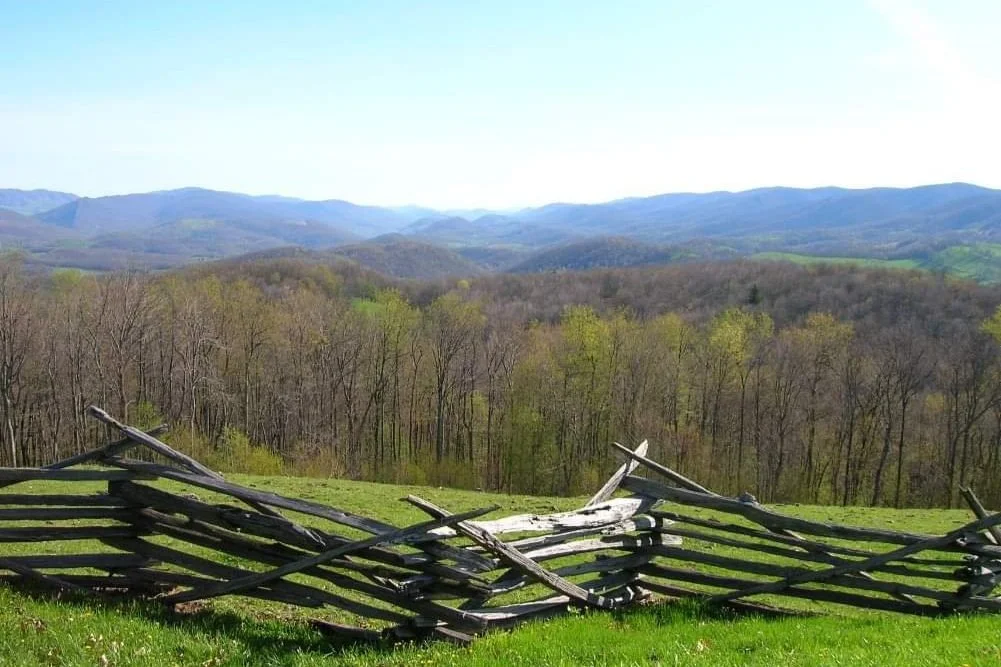
The trail leads through the core ground where Union troops climbed toward the Confederate line.
Mountain terrain, open views, and the historic village preserve the setting that shaped the fighting.
Ready to explore
Plan Your Visit to McDowell Battlefield
Begin at the orientation center, climb Sitlington’s Hill, or follow the free driving tour through the mountain landscape.