
Winchester, Virginia
Kernstown Battlefield
Two Battles on the Same Ground · 1862 & 1864
Walk the Pritchard-Grim Farm where Stonewall Jackson suffered his only battlefield defeat and Jubal Early won the Confederacy’s final major victory in the Shenandoah Valley.
The First Battle of Kernstown by Keith Rocco

The battlefield in brief
One Landscape, Two Turning Points
Kernstown became a battlefield twice: first during Stonewall Jackson’s 1862 Valley Campaign and again as Jubal Early returned to the lower Valley in 1864.
In March 1862, faulty intelligence led Jackson to attack a much larger Union force and suffer his only defeat as an independent commander. In July 1864, Early struck George Crook on much of the same ground and drove the Federals through Winchester.
- Historic site
- 1854 Pritchard House
- Public landscape
- 388-acre battlefield park
- Walking trails
- 3.6 interpreted miles
Plan your visit
Begin at the Pritchard-Grim Farm
Start with the battlefield visitor center, explore the Pritchard House and interpreted trails, then continue to Rose Hill where the First Battle of Kernstown reached its climax.

Battlefield Visitor Center
610 Battle Park Drive
Winchester, VA 22601
Begin with exhibits, military artifacts, a three-dimensional electronic map, a bookstore, and help from the battlefield’s volunteer interpreters.
Open daily, 10 a.m.–4 p.m. · Free admission · Donations appreciated

Pritchard House & Battlefield Trails
3.6 miles of color-coded trails
Guided tours available
Walk Pritchard’s Hill, follow the battle lines toward Sandy Ridge, and tour the 1854 house where the Pritchard family sheltered in the cellar during the fighting.
Guided battlefield and house tours Friday–Sunday through Nov. 1, 2026, and by appointment

Rose Hill Park
1871 Jones Road
Winchester, VA 22602
Follow the 1.2-mile interpreted trail across the ground where Union troops assaulted Jackson’s line on Sandy Ridge and the First Battle of Kernstown was decided.
Free public park · Open during posted park hours · Walking trail

Civil War Winchester Audio Tour
Stops for both Kernstown battles
Begin wherever you are
Use narrated stories, historical photographs, maps, and directions to connect the Pritchard-Grim Farm with the wider Civil War landscape around Winchester.
Free mobile experience · Pritchard-Grim Farm stops for 1862 and 1864
Before you go: Enter from Route 11 at Battle Park Drive, between Creekside Station and Subaru of Winchester. Continue straight through the battlefield gate. Tour availability may vary, so contact the Kernstown Battlefield Association in advance if a guided tour is essential to your visit.
Maps & tours
Follow the Fighting Across Kernstown
Compare modern battle maps for the 1862 and 1864 engagements, then use the historical map and driving tour to connect the surviving landscape with the wider Winchester battlefield.
Two battles require two points of view
The trails interpret both the March 1862 and July 1864 battles. Allow time to compare Pritchard’s Hill, Sandy Ridge, the historic stone wall, and the ground extending north toward Winchester.

First Battle of Kernstown
Trace Jackson’s advance, the Union position on Pritchard’s Hill, and the decisive fighting along Sandy Ridge on March 23, 1862.
View full map →
Second Battle of Kernstown
Follow Early’s July 24, 1864 attack across the familiar Kernstown landscape and Crook’s retreat toward Winchester.
View full map →
Sneden’s First Kernstown Map
Compare Robert Knox Sneden’s wartime plan of the March 23, 1862 battle with the modern map and the terrain visible today.
View historic map →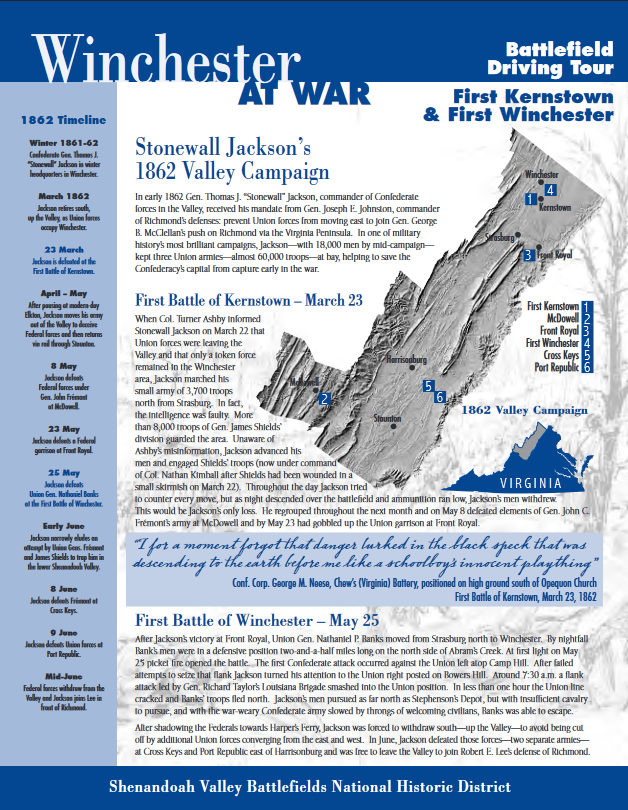
First Kernstown & First Winchester Driving Tour
Continue from the Pritchard-Grim Farm to Rose Hill and the surviving sites of First Winchester with the district’s illustrated driving-tour guide.
Open the tour guide →The history
The Battles of Kernstown
March 23, 1862 & July 24, 1864
- First Kernstown
- Union tactical victory
- Second Kernstown
- Confederate victory
- 1862 commanders
- Kimball & Jackson
- 1864 commanders
- Crook & Early
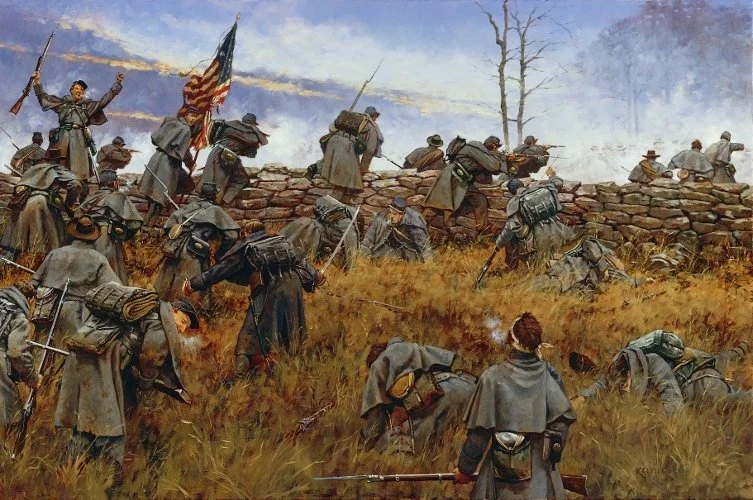
First Kernstown
On March 23, 1862, Stonewall Jackson marched north believing that only a small Union force remained near Winchester. The report was wrong. Col. Nathan Kimball commanded a much larger force while the wounded Brig. Gen. James Shields remained behind the lines.
Kimball placed artillery on commanding Pritchard’s Hill. Jackson shifted west toward Sandy Ridge, where his infantry and guns formed near a stone wall. After hard fighting, Erastus Tyler’s Union brigade and supporting troops pressed the Confederate line. With ammunition running low, Brig. Gen. Richard Garnett ordered a retreat.
The Union won the field, giving Jackson his only defeat as an independent commander. Yet the attack alarmed Washington and helped keep Federal reinforcements in the Valley rather than sending them to the Peninsula Campaign.

Second Kernstown
On July 24, 1864, Jubal Early returned to the same landscape and found George Crook’s army south of Winchester. Crook believed the Confederate threat was limited, but Early had brought a stronger force than expected.
Union troops held Sandy Ridge and Pritchard’s Hill before Confederate pressure spread across their front and flank. After stubborn resistance, the Federal line collapsed. Col. James Mulligan was mortally wounded while trying to rally his men, and Crook’s army retreated through Winchester toward the Potomac.
Second Kernstown was the Confederacy’s last significant victory in the Shenandoah Valley. The setback helped convince Ulysses S. Grant to unite Federal forces under Philip Sheridan, setting the stage for the decisive 1864 Valley Campaign.
How the story unfolded
The Same Ground, Different Outcomes
Pritchard’s Hill and Sandy Ridge became key terrain in two battles separated by more than two years.
- March 23, 1862
Jackson Advances on Faulty Intelligence
Expecting only a rear guard, Jackson instead confronts thousands of Union soldiers south of Winchester.
- 1862 · Afternoon
The Fight Shifts to Sandy Ridge
Confederates form near the stone wall while Union troops move west from Pritchard’s Hill to attack.
- 1862 · Evening
Jackson Withdraws
Outnumbered and short of ammunition, the Confederate line gives way—the only battlefield defeat of Jackson’s command career.
- July 24, 1864
Early Returns to Kernstown
Early’s army strikes Crook’s position and brings unexpectedly heavy pressure against the Federal line.
- 1864 · Evening
The Union Line Collapses
Confederate attacks drive Crook through Winchester and briefly restore Southern control of the lower Valley.
Part of a much larger protected battlefield landscape
Preservation in action
A Battlefield Saved by Partnership
The Kernstown Battlefield Association preserves and interprets the 388-acre Pritchard-Grim Farm through the work of an all-volunteer organization. The Shenandoah Valley Battlefields Foundation has protected additional Kernstown acreage, while Frederick County and the Museum of the Shenandoah Valley provide public access at Rose Hill.
The historic house, farm buildings, stone walls, ridges, and open fields preserve the setting of both Kernstown battles.
Trails, tours, exhibits, and partner sites allow visitors to follow the fighting across a battlefield surrounded by modern growth.
Ready to explore
Plan Your Visit to Kernstown Battlefield
Begin at the Kernstown Battlefield Visitor Center, walk the Pritchard-Grim Farm, and continue to Rose Hill to see where the First Battle of Kernstown was decided.